


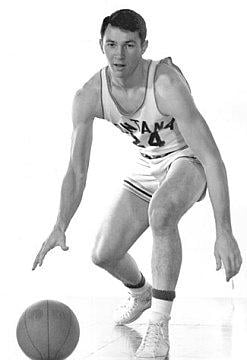
John Holliday can't remember who the Grizzlies were playing when he set the Adams Field House single-game scoring record of 37 points back in early 1966.
He thinks it was against Portland State in a 94-68 win but said it could have been against Idaho State during a 111-84 Grizzly runaway.
But he does remember where he was on the court when he launched the record-setting shot.
"It was on the left-hand side of the court," Holliday said, "probably about 20, 25 feet away."
Holliday said setting the Field House scoring record was "surprising" to him.
"I didn't have any idea that I was that close, and I was pulled out of the game," he recalled. "Next thing I know Bob Cope and Ron Nord said, 'we're putting you back in and you're gonna make the record.'"
People are also reading…
Holliday's teammates kept feeding him the ball, something he wasn't used to.
"I know I was just throwing up any shots (with) any slight little opening," he recalled, noting that the record-setting shot came just before the game ended.
Cope still shares the UM scoring record with 40 points in 1948. Micheal Ray Richardson tied it in 1976 against Montana State.
Holliday does remember when he got the news that he would only be able to play one season for Montana even though he had been promised two by then-head coach Ron Nord.
Following the 1965-66 season the Big Sky Conference declared him ineligible, apparently because of a redshirt year he had spent at a California junior college.
Holliday thinks it was shortly after that when the NCAA established its five-years-to-complete-four rule.
Even before he started playing for UM he was receiving letters from a small-college coach in Nevada warning him that he would only be able to play one season. But Nord and Cope kept insisting that he would be able to play two.
Following his senior season in high school at Charlottesville, Ind., he was approached by a coach from the area who said he could continue his career in California, if he wanted to.
At the age of 18 he left small-town Indiana for Santa Maria, Calif., where he had a redshirt year and two playing years for Allan Hancock Junior College and where, coincidentally, John Madden was the football coach.
Holliday was noticed by legendary ex-Griz star Bob Cope, who was coaching another junior college at the time and was just about to join Nord's UM staff as an assistant coach.
As for his nickname, it almost seems strange that it took him until he was in junior college to become tied to the Old West legendary gambler and sidekick of Wyatt Earp.
"I think it came from the players I was around and kind of followed along to the coaches and then everybody in the school picked it up," Holliday recalled. "And the newspapers and all that. So that carried with me all the way up through the days at the University of Montana."
Since left Montana in the late 60s Holliday says the nickname has sort of fallen by the wayside.
However, "Doc" wasn't the only nickname Holliday would be tagged with.
Legendary radio announcer Cato "the Cat" Butler, who was calling Grizzly games at the time, played off the "Doc" nickname a little bit, dubbing Holliday the "Crystal Pistol."
Holliday thoroughly enjoyed the one year he had playing for UM.
"Coming from the high school that I came from through the junior college level, and then coming to a four-year school which was an NCAA Division One school, I really didn't know if I had the capability or the talent to compete at that level," Holliday recalled.
The Grizzlies opened the 65-66 season with a pair of wins. Holliday got right into the flow and his confidence increased right away.
"It just got better as we went on," Holliday explained. "You got more confidence. I think at one point that year we had a nine-game winning streak (actually eight, and UM won 10 of its last 12 games), and I think it was the longest or maybe the second longest in the nation at that point."
Holliday especially enjoyed his Grizzly teammates.
The starting center was John Quist from Cut Bank, the forwards were Norm Clark from Milwaukee, Wis., and Greg Hanson from Missoula, and the other starting guard was Gary Peck from Libby.
"We had a nice little team there," Holliday said. "We worked well together, and we knew everybody's strengths and weaknesses, and we played off of that."
Holliday also enjoyed playing for Nord.
"I had to apologize to him because I remember playing Montana State down there for the first time, and towards the end of the game I kind of went off the game plan," Holliday said.
"I kind of took the ball and did my own thing, and was being fouled and had to go to the free throw line. I made 13 free throws in a row, and we won the game (80-76)."
Holliday was somewhat surprised by Nord's reaction.
"Ron's comment was, 'listen, just play ball,'" Holliday remembered. "'That's all we care about. We want to be structured, but if there's other things that come about just go ahead and take advantage of them.'"
Holliday's career was a series of adjustments, from the structured style of Indiana high school ball to the more free-wheeling style in junior college back to more structure at Montana.
"Junior college was more or less a fast-break offense," Holliday said. "Once the ball's rebounded you break it out and you go full tilt. If they are back there on defense then you set up your offense."
Holliday said there was more emphasis on defense at his junior college because it helped spark the fast break. So he felt confidence in his defensive abilities when he arrived at UM.
"We did more (fast break at Montana) than I thought (we would)," Holliday said. "I think the other players grabbed hold of that and enjoyed it, too."
The Grizzlies finished 14-10 that season, with Holliday as the leading scorer averaging 17.8 points per game. The team scored 100 points or more three times. Holliday and Quist were second team all-Big Sky selections.
Nord and Cope were as disappointed as Holliday when they learned he was ineligible for a second season, so they offered him a job as freshman basketball coach to help him finish school.
Not sure he would be able to get a scholarship elsewhere to play just one season, Holliday took the offer.
"I thought it was better at that point to just to finish out my education," he said. "The university was very good and gracious to give me the opportunity to coach the freshman team."
While in Missoula Holliday also met Margaret DonTigny of Havre, a Grizzly cheerleader. The two were married in August, 1968, just before he went into the military.
Holliday had gone through Army ROTC while at UM, thinking that was a better option than being drafted during the Viet Nam War.
"I figured I'd rather go in as an officer than as an enlisted man," Holliday recollected.
During the first year after he was commissioned Holliday was a training officer at Ft. Lewis, Wash. Despite the fact that nearly everybody else around him was being sent to Viet Nam, he was shipped to South Korea, to a post along the Demilitarized Zone just south of North Korea, where he spent six of his final 13 months in the army.
"I was the executive officer, so I was on the DMZ every other night, just to make sure everything was okay and nothing happened," Holliday said, adding that no wives were allowed to travel there.
Asked if he gave any thought to staying in the military, Holliday quickly said, "No," even though his wife thought it might be a good idea.
After his release from the military Holliday returned to Missoula to work for a few months, hoping to put his health and physical education degree to work as a coach.
He landed a teaching and coaching job at a small high school near State College, Penn., but after four years became somewhat soured because basketball was a distant third in importance there to football and wrestling.
"Basketball was considered a minor sport," Holliday said. "The first year I got one victory. I got beat (by) 30 and 40 points every game. We had a gymnasium that would probably hold 800 or 900 people, and we may have gotten 20 people there (for basketball games)."
After improving to a .500 record his third and fourth years there Holliday said attendance didn't improve that much.
"It was disappointing because not even the parents of the ballplayers would come," Holliday noted. "I thought I was just dying there. It was a dead end."
So he got out of coaching for good, moving to Washington, D.C., to work for a former college roommate who had a company that rented audio-visual equipment to hotels. After about 10 years Holliday moved to another company in the same field.
That evolved into his own company - World Congress Interpretation Systems, Inc. - which rents equipment for interpreters to use during international meetings. That means a lot of work with the Federal government.
He's been president of the company for about 10 years.
"It's exciting, and you deal with a higher level of people in different governments," Holliday explained. "There was just a lot about that that appealed to me."
Retirement is probably about five years down the road for Holliday, perhaps a couple years less for Margaret.
Might retirement bring them back to Montana?
"There's all kinds of pressure to move back west," Holliday said. "I told Margaret one time, 'I wouldn't mind retiring in Montana.' I said, 'but we'd have to live in Indiana for at least 10 years to share the families.'
"She didn't like the idea because Indiana's very flat and corn field after corn field," Holliday laughed. "But no, I enjoy coming back to Montana. There's a possibility we could move back here."
They have four children: Angela, 38, married with four kids and living close by in Maryland; Ryan, 33, living in Los Angeles while pursuing an acting career; and Nick, 25, living in Falls Church, Va., and working in the nation's capitol.
Angela probably was the best athlete of the three, setting high school long and triple jump records in high school but not continuing in track and field when she went to Purdue University.
Ryan played some high school soccer and baseball, while Nick played some basketball but mostly soccer in high school.
There's no doubt that Holliday's life has been a series of adjustments. He looks at each move he's made - from Indiana to California to Montana to Pennsylvania to Washington, D.C. - as exciting.
But nothing has topped the excitement of living in Washington, D.C.
"You're in the center of the Federal government and all the activity that takes place there," Holliday explained, "with the politicians and the politics. It's exciting."
Holliday remembers when a good friend from Vancouver, Wash., came to visit him, having never been to Washington, D.C.
They toured most of the monuments, the government buildings and the White House.
His friend said, "Now I see why Washington, D.C. is so powerful, and why the United States is such a powerful nation, because it's all right here."


