


BYNUM - Unlike Many Glacier, Old Faithful or Beartooth Pass, your grandmother cannot visit the Rocky Mountain Front and bring you a lousy T-shirt about it.
That's because if your grandmother has ever been to the Front, it's probably her favorite place in the world and she's kept her mouth shut about it. Also, there's almost nobody there selling T-shirts.
Part of that is down to the Front's almost Patagonian style of repelling humans. When the wind gets blowing, you quickly understand why the pine trees are 6 inches tall and 20 feet long. No rail line delivers tourists, like Glacier National Park enjoys. There is a ski area, but frequently no snow. The beautiful creeks hold few fish.
We'll get to the grizzly bears in a bit.
"It's just rough old country," says Bill Cunningham, an outfitter and writer who abandoned Montana's big cities to settle in Choteau. "It's rougher, more austere, more sparse country that isn't going to appeal to every taste."
People are also reading…
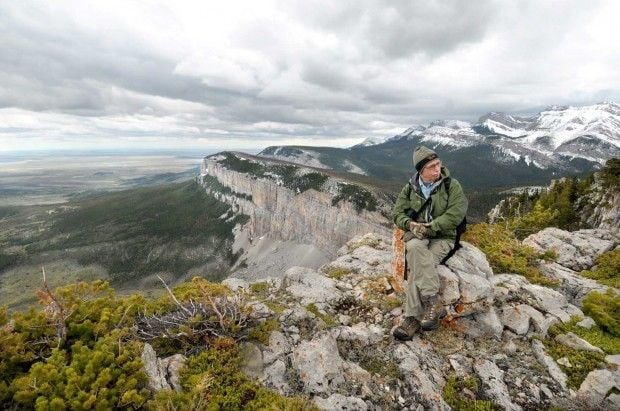
Hearing Front-lovers like Cunningham describe their mountains resembles the geological equivalent of a wine-tasting class. The Rocky Mountain Front bursts abruptly from the eastern plains, compared to the Beartooths' more prolonged buildup. Its gray-orange limestone has a particularly abrasive nature, unlike Glacier's soft red and green argillite. And for a place with a dominant landmark called the Chinese Wall, it's surprisingly accessible.
On the other hand, where else in Montana can you see a sea of nameless peaks? Just elevation numbers on the map. Talk about splendid isolation.
Retired Great Falls Tribune editor Tom Kotynski recalled coming to Montana from Chicago 37 years ago with plans to explore every inch of Glacier National Park. But he ended up writing a book titled "Discover the Rocky Mountain Front: A Hiking Guide."
"When I moved here, the first thing I did was head for Glacier Park every weekend," Kotynski said. "But you can't drive from Great Falls to Glacier Park without noticing those wonderful mountains out to the west. I got curious right away about going into them."
***
No Going-to-the-Sun Road crosses the Front, but several good drives make the place visitable by vehicle. The Willow Creek Road from Augusta into the Sun River Game Range gets a stampede of traffic on the May 15 opening of elk-antler season, and then returns to a lonely scenic drive at the foot of Sawtooth Ridge the rest of the summer. The Sun River Road breaks off to the northwest and weaves through a canyon to Gibson Reservoir. If your rig has reasonable clearance, the Beaver Willow Road runs about 20 miles south from the reservoir to the Benchmark Road, which will loop back to Augusta.
Because the real splendor of the Front comes best on foot or horseback. Its mountains form a series of north-south ridges and walls, a cross-section of "thrust sheets" of Paleozoic rock layers that snapped and bent skyward above the continental shelf to the east.
These walls have a few perpendicular cracks. For example, Blackleaf Creek is finishing the job a glacier started long before in carving an entrance to the northern Front. It's one of Cunningham's favorite starting points, and he's made about a dozen scrambles up Volcano Reef over the years to show visitors the majesty of the plains and peaks.
"There's a richness of natural diversity here," he said on a rare windless day atop Volcano Reef. "All the charismatic megafauna are here, including the buffalo. The wolves are coming back. And it's the only place on the Rocky Mountain Front between Mexico and the Yukon where you still have grizzly coming out on the plains to live their annual life cycle."
Two centuries ago, explorers Meriwether Lewis and William Clark first started running into grizzlies near the Montana-North Dakota border. As settlers laid out farms and ranches, the big bears wound up with only the toughest parts of the Rockies for a refuge. But around Choteau and Augusta, they still come down to roam the grasslands.
The grizzlies leave their calling cards everywhere, from scratching trees in creek bottoms to huge scats on the edge of mountain ridges. Last August, a poacher killed one known locally as Maximus who was estimated to weigh more than 800 pounds.
Dupuyer rancher Karl Rappold knew Maximus, and never had a problem with bears messing with his cattle. His mailbox features a sheet-metal silhouette of Charlie Russell's painting of a cowboy roping a grizzly.
"You should have seen Maximus' dad and his grandpa," Rappold said. "He was a baby compared to them."
Bighorn sheep and big herds of elk also wander through the Front and its foothills, attracted by some of the last unbroken prairie grasses and the blasting winds that strip the snow away in winter.
And there's also evidence of much earlier life. The limestone "reefs" aren't true coral formations, but they do encase fossils of corals, trilobites and other residents of the ancient inland seas that used to cover this region. In his book, Kotynski noted many trips have been stalled by the investigation of some new deposit of prehistoric life.
"I'm just drawn to the drama of the Front," he said. "I don't think you've got that anywhere else in the state. It's sort of the pivot point. Any place you pivot, you're seeing a different aspect of Montana."


