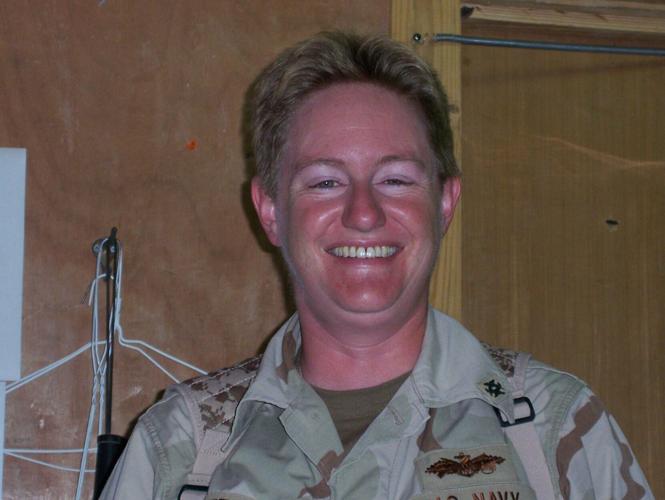







Sheila Stenzel, Naval Civil Engineering Corps Officer
The thought had always been lodged in the back of her head.
But it took hearing an ad on the radio to make Shelia Stenzel pull the trigger, so to speak. At 31, she thought, why not finally join the Navy Reserves?
“It was always something I wanted to do,” she said.
Working full-time as a computer programmer, with a husband and stepdaughter at home, Stenzel realized she had already punted the dream to serve in the military in some capacity since her college days at Montana State University – Bozeman.
“By the time I looked into it back in college, it was too late. I just couldn’t fit in all the credits I would have needed, so I just went on with my life. But when I heard that ad on the radio, I thought, well, it’s now or never,” she said.
Stenzel joined the Navy Reserves and underwent its 3 ½-week basic training camp at the Naval Station Great Lakes in Illinois.
“Training took place in December and, boy, was that water cold,” she said.
Because there weren’t any officer positions open upon her completion of basic training, she became an undesignated E-3 and continued on with her life, which now included monthly weekend drill time and two weeks of training each summer. A year later, an officer slot opened up, and Stenzel put in her papers for the position — 9/11 had just happened.
“The reserve center was locked down during that week,” she said, “so they had to cobble together two officers to come in so I could take my oath.”

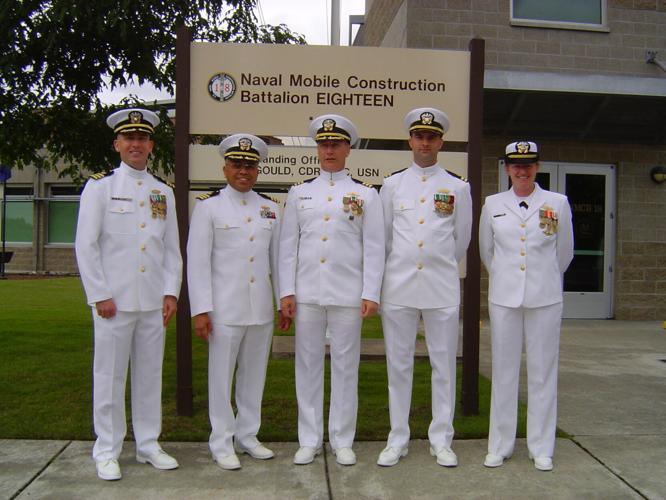
Sheila Stenzel and her fellow Navy academy graduates
Because she had a degree in mechanical engineering, Stenzel became a Naval Civil Engineering Corps Officer for Naval Mobile Construction Battalion 18 (NMCB), known as a Seabee battalion. The unit provides essential engineering, tactical construction, disaster relief and logistics support to naval and joint forces throughout the world.
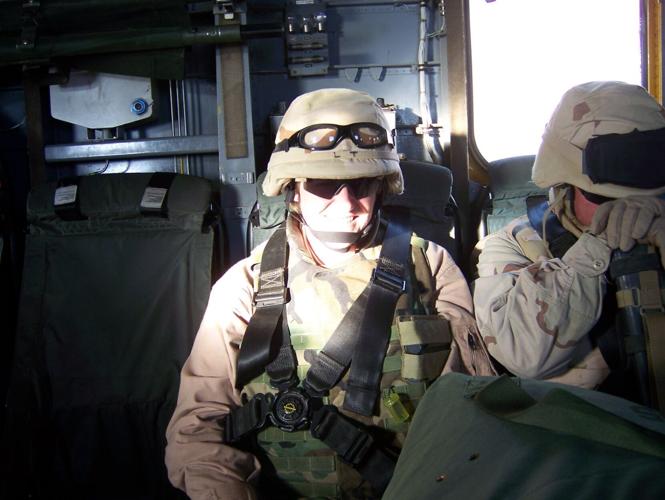
In 2006, her unit deployed to Iraq’s Al Anbar Province where she worked across multiple bases with a detachment of 100 people, performing whatever projects they were asked to do. The unit was made up of engineers, steelworkers, electricians, plumbers, mechanics and other trade specialists, along with administrative support staff.
“While we were doing vertical and horizontal construction projects it was still, obviously, all being done in a combat environment,” Stenzel said. “We worked 24/7. War zones don’t take breaks. We installed plumbing and electrical, built a lot of housing, did road repair work, runway construction, whatever was needed to sustain the troops.”
Stenzel said insurgents would shoot three to four rockets a day at them.
“They didn’t do any effective damage, but they would do it every day for the nine months we were deployed there,” she said. “While there’s certainly an adventure component to being there, Iraq is not touristy. I saw things most people will never see.”

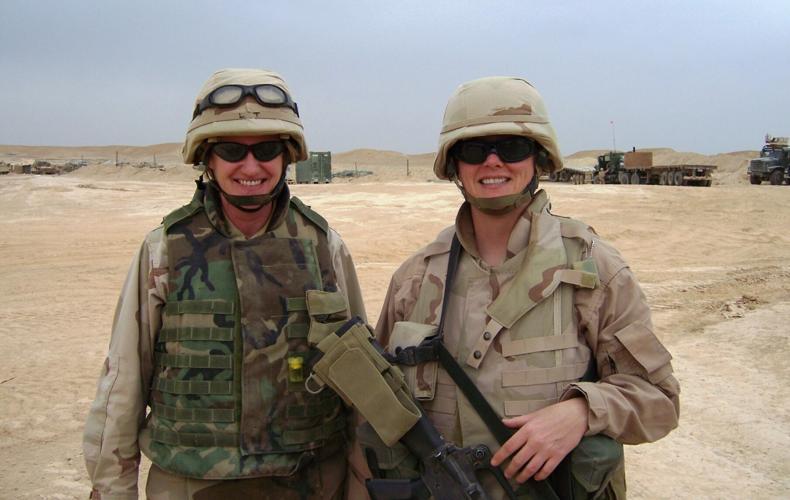
Sheila Stenzel with a fellow officer in Iraq
Stenzel said the unit had to make do with whatever tools and equipment were available at the time.
“From cold weather gear to bulldozers and backhoes, we were constantly short of something,” she said. “Because of procurement issues and supply chain problems, there were definitely things we wished we had and didn’t.
“When you need a backhoe, for example, you just can’t go and buy one down the street. By the time we got to Iraq in 2006, the procurement process was still trying to catch up. We were often dealing with older equipment and had issues trying to get parts,” she said. “But I tell you, there was a lot of pride in not having perfect gear and being able to make things work.”
Stenzel said working with the Seabees was a remarkable experience.
“They are so hardworking and just so good at what they do,” she said. “You can ask them to move the world with a pick and an axe and they will do it.
“Funny thing, too, is all the bookwork goes right out the window when you’re in those situations. Like pouring concrete in 110-degree weather. Everything is hands-on and in constant motion. We weren’t sitting at a desk in an air-conditioned office looking at plans,” Stenzel said. “Yes, I am an engineer, but there was not much in the books that could teach us what we had to do over there.”

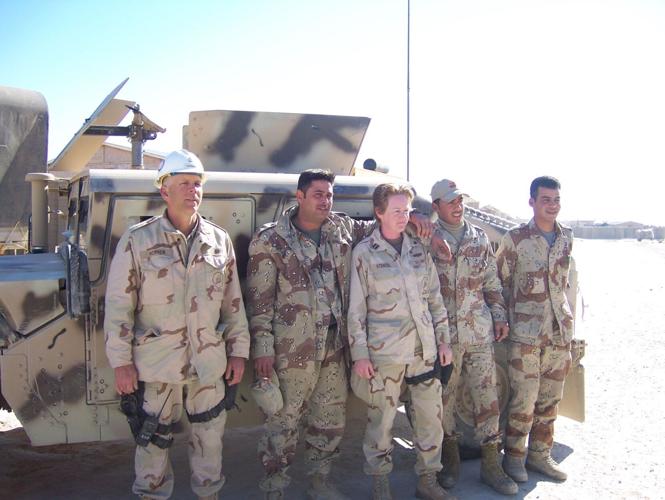
Sheila Stenzel poses for a photo with Iraqi Army members
She said one of the “coolest” things she likes to remember about her time is when they built a small city in Ramadi for a regiment that was on its way over there. The work included constructing 36 40-by-80 plywood buildings for the troops to sleep in.
“We built them in six weeks at breakneck speed,” she said. “I’ve always been impressed with my troops for that work. I had experts coming in to set up all the electrical and plumbing. It was very impressive.”
Six months after she returned from Iraq, she decided to transfer to the United States Forces Korea (USFK) command, which helps maintain stability in Northeast Asia. The U.S. and the Republic of Korea have maintained the Armistice for more than 70 years, setting the conditions for stability and prosperity in the Republic of Korea.
She spent three weeks in Korea each year training with the Korean units for three years. Following her time with USFK, she took the position as communications officer for the First Naval Construction Regiment (1 NCR), which oversees multiple subordinate Seabee battalions, and remained in that position until her retirement from the Reserves in 2012.

In addition to her initial job as a computer programmer, Stenzel also worked alongside her husband in his business and was a guitar maker for six years at Gibson Guitars as well.
“I know,” she said laughing. “I had never played the guitar when I took the job, just the piano and the sax. But I always seem to keep coming back to constructing, making things.”
Today, Stenzel works as a property tax assessor for the state of Montana and lives in Townsend.

Sheila Stenzel, today
“Building now? It’s a young person’s game,” she said. “I’m 57 now and perfectly happy doing a little less physical labor and more office work and planning. But I certainly do miss the people I worked with in the Reserves. I have a lot of pride in the work we did, and for serving my country. The people I served with and worked with every day is something I would not change. It’s part of my DNA and makes me who I am today.”
As for advice to someone thinking about joining the military, Stenzel recommends they find someone in the military who does what they think they want to do.
“Whether it’s to become a pilot, a mechanic, construction worker, whatever they think they might want to do in the military, find someone who does just that,” she said. “Military movies imply it’s way more glorious than it really is. Day to day they might be doing something they don’t like. So the best way to find out is to talk to someone who is actually doing what they think they might like to do.”