

A business owner needs to update a website before the busy season. An AI tool produces the first draft quickly. But the result could describe almost any business in almost any city. The sentences are polished. Yet the people, places, and practical details that earn local trust have disappeared.
The solution: going through a useful editing process must restore the knowledge and personality that distinguish a local organization from a generic competitor.
Begin With Facts Only a Local Would Know
Before revising the draft, list the details that should make the page unmistakably local. These might include the neighborhoods served, seasonal conditions, regional terminology, delivery boundaries, or questions customers regularly ask.
A landscaping company, for example, gains little from saying it creates “beautiful outdoor spaces.” Explaining how it selects plants for a city’s short growing season gives readers information they can use.
People are also reading…
Check every draft for three forms of specificity:
- A recognizable place or service area.
- A concrete customer concern.
- An example grounded in local conditions.
Replace Stock Language With Customer Language
Generated drafts often rely on phrases such as “high-quality solutions,” “exceptional service,” and “committed to excellence.” Such statements make claims without showing readers what the organization actually does.
Replace them with language customers use in conversations, emails and reviews. A repair shop might explain that it helps drivers prepare older vehicles for winter starts. A neighborhood bakery could describe when its morning bread leaves the oven. Specific information sounds more credible because readers can evaluate it.
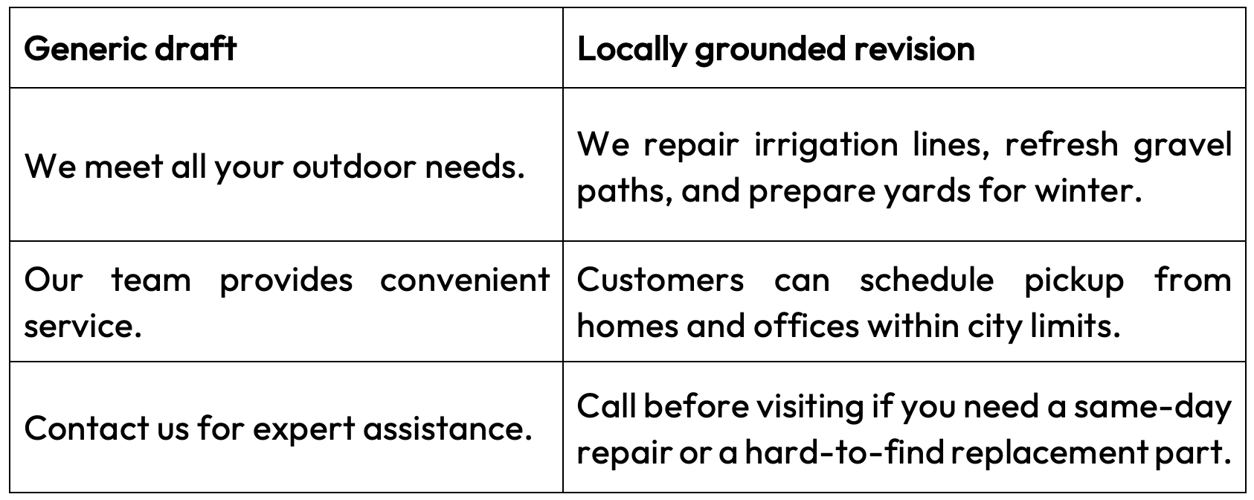
Use a Side-by-Side Editing Test
Compare each important sentence with a more concrete alternative:

Keep Technology in a Supporting Role
Automated tools can help reorganize a paragraph or identify repetitive wording. But the business must remain responsible for accuracy and tone. During revision, an AI humanizer may be used to examine stiff or formulaic passages. Any suggested language still needs human review against actual services, policies and local knowledge.
Never allow smooth phrasing to introduce an unsupported promise. Confirm prices, hours, addresses, availability and service boundaries before publication. Also see, if a page covers safety, legal requirements or public services, verify the information with the appropriate primary source.
Read the Page as a Neighbor Would
A final review should consider how the copy sounds outside an editing screen. Read it aloud and mark sentences that feel overly formal, crowded or unlike something an employee would say to a customer.
Then ask:
- Could this page belong to a business in another state?
- Does it answer the question that brought the reader here?
- Are local references accurate and genuinely useful?
- Would an employee recognize the organization’s voice?
- Can every factual statement be verified?
Final Thoughts
AI can shorten the distance between a blank page and a workable draft. It cannot supply the lived knowledge that gives local communication its value. That voice returns through careful editing: adding precise details, removing empty claims and checking the page from a neighbor’s perspective. The goal is not to make technology invisible. It is to ensure the finished website remains accurate, useful and recognizably connected to the community it serves.