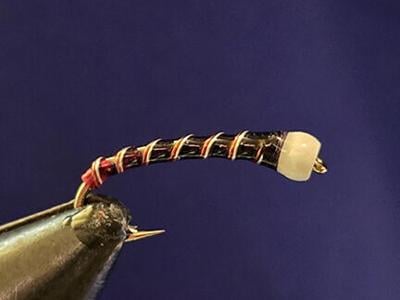

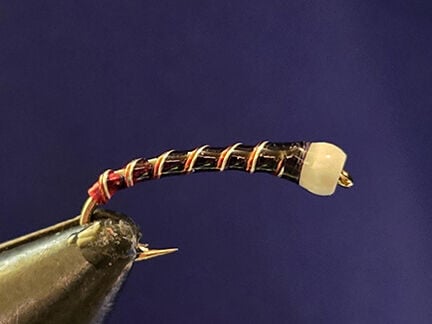
Hook, thread and materials
Hook: Curved nymph hook 2x long (shown size 16).
Thread: Purple 70 denier, red 70 denier; preferred brand is UTC.
Rib: Small silver and red ultrawire.
Bead: White brass or tungsten, sized appropriately. The bead can be put on with the wide part facing the eye, so make sure not to oversize it.
Other tools: Fly finisher (UV resin, Krazy Glue, or clear polish).
Preparing the bead and hook
Start by putting on your bead. It can be put on backwards, with the wide part toward the eye of the hook. The hook shown is a size 16 and the size of the bead is 3/32-inch. This chart is helpful when sizing beads with hooks. Even so, it can take trial and error to get a size you like.
People are also reading…
Tying the body and rib
Start with your red thread and use it to tie in your wire down the shank of the hook. Tie the wire right behind the bead to keep the body of the fly uniform. Tie the two pieces of wire in together to the back of the hook. Then take about three wraps of thread beyond where you will start wrapping your wire. This gives the fly a small red butt.
Continually unwind your thread to keep it flat. You can do this by spinning your bobbin counterclockwise. UTC thread flattens well, but you have to keep spinning it to keep it flat. A flat thread is important to the finish of the fly.
Wrap the red thread back to the bead, then whip-finish and cut it. Start your purple thread, which you will use to build the body and taper. Wrap the purple thread toward the butt of the fly. Make sure the thread is flat and, as you approach the butt, spread the last two wraps out a bit. The goal is to create a transition between the red and purple colors so they blend in this area. Once that is done, use the purple thread to build a taper back to the bead.
Next, take the two pieces of wire and wrap them together in wide spiral wraps up to the bead. Keep the wires together as best you can and try to get about six wraps. Flatten your thread to tie off the wire. Hold the thread tight and helicopter the wire to break it. Then flatten your thread again and whip-finish.
Finishing the Purple Ace
The fly can be finished with Bone Dry UV resin. You can also use Krazy Glue or clear nail polish, such as Sally Hansen's Hard as Nails. The resin will give it a shell-like look, and any of these options creates a durable fly.
How to fish it
Midges are common across the West and are food for trout in rivers and lakes. The larval stage of a midge is what this fly imitates. It is in the wide family of chironomid patterns. These chironomids come in a wide variety of colors, but in Montana, this pattern is often tied with a red butt and either this dark purple, which looks black, or just black.
Most of the time when chironomids are found in throat samples from trout, they are very small. For that reason, the fly is tied small and fished under an indicator about a foot or two off the bottom.
You can also fish these in lakes with a long leader and floating line, slowly stripping them. In rivers, they can be fished as a dropper off a larger nymph, as they are very small.