


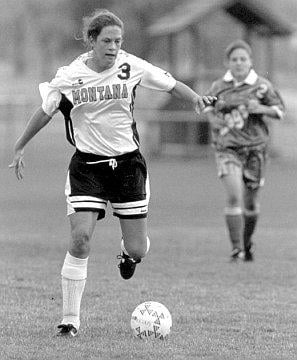
It's probably no surprise to her former college teammates that Maggie Carey is writing and directing comedy shorts in New York City.
She plied her comic trade while playing soccer for the Montana Grizzlies and fell back on her sense of humor when her playing time dwindled during her final season.
Married in 2006 to actor Bill Hader of Saturday Night Live fame, Carey keeps busy providing comedy to the Internet while also working on projects that might catch on with television.
Some of the made-for-Web video has been used by Warner Video 2.0. Carey also has placed stuff on Comedy Central and is partnering on material for a new company in Brooklyn.
An English major at UM who also took some radio-television courses and worked part time for Montana PBS, Carey got her first "major" exposure to video production by putting together the highlight video for the Griz soccer team after the 1996 season.
People are also reading…
"In doing that video we had a lot of jokes and stuff," Carey recalled.
Following graduation in the winter of 1997-98 Carey signed on for film school at the University of Texas, and then took a job as an editor for reality shows in Los Angeles. Her engagement and subsequent marriage to Hader took her to New York City when he picked up the role with SNL.
She and Hader met when she went to watch him perform in a comedy sketch group that put on shows in friends' back yards.
"They didn't actually ever perform in a theater," Carey said. "They were very underground."
She said Hader was wearing overalls and no shirt in the first skit she saw him in.
"I'm from Idaho, so that's clearly a turn-on right away," Carey said of the costume. "So we kind of just hit it off and definitely shared an interest in comedy."
One of the projects Carey's helping develop for possible television use is called "The Jeannie Tate Show." It's about a soccer mom who does a talk show from her minivan.
"She's actually driving around running errands, and she'll have a guest, but she's actually doing it from her minivan while she's carting her kids around," Carey explained.
The newest project she's helping promote is called "Lady Ref," inspired by a "favorite" referee Carey and her UM teammates had.
"It's just four lady referees who work at parks and rec," she said, "but we're treating it as if it's a prime-time soap opera."
Carey said a dose of sarcasm helped carry her through the part of her UM soccer career that was more bench oriented.
The Boise native played for only three years for Montana, but they just happened to be at the start of the women's soccer program at the school.
Women's soccer programs were not as plentiful then as they are now, so Carey didn't play soccer at the University of Idaho as a freshman. Boise State didn't have women's soccer at the time, either.
"I needed to stay in state for financial reasons," Carey recalled, not knowing that her soccer career wasn't over.
Soon after she was hired, new UM coach Betsy Duerksen called - among others - coaches of former Idaho youth players to see if any might be interested in helping her start the new UM program.
"Thank goodness my Olympic development coach . . . knew that I still wanted to play, so she (Duerksen) called me and I was absolutely ecstatic," Carey said, "because I wanted to get out of Moscow so badly."
Carey resumed training right after Duerksen's call, hoping that her recruiting trip to Missoula would turn into a chance to play.
"I went and visited and absolutely fell in love with Missoula," Carey said. "It was the prettiest place I'd ever seen. It was an absolute no-brainer when they asked me to come and play."
Despite her happy-go-lucky approach to things Carey was "petrified" about transferring to Montana to play college soccer. She worked out with her former club team, but worried about dealing with so many unknowns.
"Growing up I never really thought I would ever have the opportunity to play in college," Carey said. "It was really my senior year in high school when I actually realized that maybe I could continue playing."
Now Carey doesn't hesitate to talk about what she got out of playing soccer: the camaraderie and all of the things she learned from being an athlete.
"I'm so incredibly lucky," Carey said of her chance to continue playing soccer. "I thought that chance had been taken away or it wasn't going to happen, and then to get that call from Betsy really was monumental."
Despite her misgivings at the time, Carey said it was "fantastic" to be involved in starting a new program and to receive such tremendous support so quickly.
"I just think Missoula is such a unique town and the support from our fans was just amazing," Carey said. "Even just walking down the street people would recognize you."
 Carey recalled
a group of guys who brought their drums to the home games.
Carey recalled
a group of guys who brought their drums to the home games.
"They were really crazy, intelligent guys," Carey recalled, "so the comments they would yell (at the opponents) were very witty and sarcastic, always really funny (and) not necessarily mean."
The UM players also forged strong relationships with younger players in the Missoula area, sticking around to coach during the summers.
Carey said the first year "was really rough, but really fun." It was a year full of travel because of UM's lack of its own home field.
"They (got) tiring," Carey said of all the road trips, "but you definitely (bonded)."
The trips also gave Carey a stage on which to perform. Sometimes when they flew, she would take it upon herself to play the stewardess and give safety instructions to everyone on the plane.
At least somewhat self deprecating, Carey said she leaned toward comedy "probably because I wasn't the best player."
As the years went by Duerksen kept bringing in better and better players and Carey saw less and less playing time. But she understood what was going on, and still has the utmost respect for Duerksen and the program she helped build.
"She's just an incredible person," Carey said. "She's one of the smartest coaches I've ever had. She was also the first female coach I've ever had, and that was really, really great to see.
"She is such a well-rounded person," Carey added. "She's an awesome mother and a brilliant wife. You just never wanted to disappoint her."
Carey went on to say Duerksen is one of the most influential people she's had in her life. She remains in touch with Duerksen and the corps group of women that came to start the UM program in 1994.
"I think we felt like the underdogs," Carey said of the 1994 team. "I think that a lot of us were excited just to be playing, but you also realized how well developed other programs were, and sometimes it felt like maybe we didn't have everything that other schools had."
The other thing that helped make the first year more bearable was that the women all lived in the dorm together.
"So (there are) lots of memories of watching "Days of Our Lives" while we were putting on our shin guards," Carey remembered, "and then walking across campus 'cause we had to drive to the field.
"And then that long walk back when we would always be so exhausted," Carey added. "It was great. I look back (on it) fondly."
Things took a turn for the better when the team moved into the South Campus Stadium for the 1995 season.
"I mean, that field was beautiful," Carey said. "I look now at team photos and videos, and you have the mountains in the background. It's absolutely the prettiest field I've ever played on."
The field also was large, something Carey said benefited the UM team because of the speed of its forwards. But it did make it a bit tougher on defenders like Carey who weren't quite as fast.
Carey said, "Not often enough," when asked if she gets back to Missoula much. She's made it back for a couple of soccer alumni games.
She hopes to bring Hader, who has never been to Montana, next spring.
Carey stays in closest contact with former teammates like Margo (Tufts) Young, Courtney (Mathieson) Jenkins, Karen Hardy, Nikki Grossberg and Lisa Oyen.
"I think it really prepared me for everything I've been doing," Carey said of her UM experience. "In terms of filmmaking and acting and with comedy and putting together productions, I'm constantly comparing it with sports.
"Your coaching and your practice and your preparation and then when it's actually game day," she added. "I perform comedy improv in front of a live audience.
"There's a couple of other athletes that perform as well that are actors, and we're always joking that it's game day."
She also sees a strong comparison between coaching and directing.
Carey said it sometimes was tough scheduling when she was a full-time student and a college athlete and dealing with the pressure to perform athletically. But in the long run she said it's made everything she's done since seem easier.
"It was really fun," she concluded.
Despite the excitement of working in the Big Apple, Carey said she still misses Montana.
"It's one of the most beautiful places in the world," she said.


