
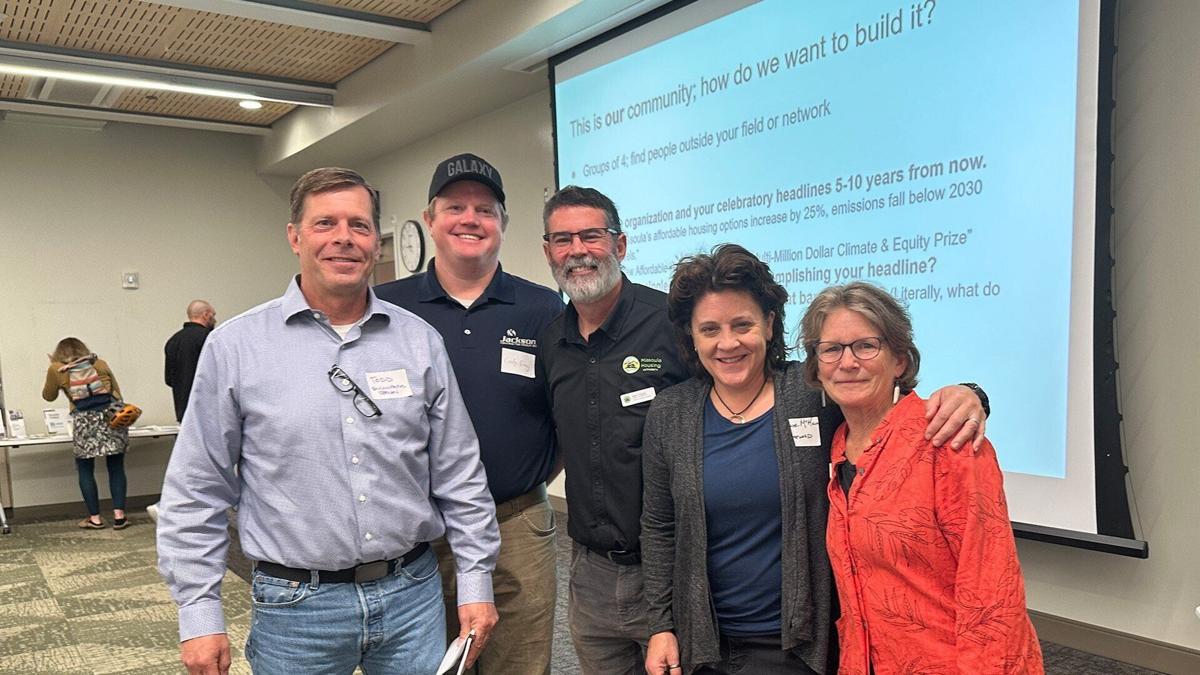
Missoula – Local government leaders, industry professionals, and affordable housing and climate advocates recently convened for “Building Solutions,” a Climate Solutions Week gathering focused on the intersection of affordable housing and climate solutions.
Hosted by Homeword and Climate Smart Missoula, alongside Missoula Housing Authority, the event offered a generative space to share ideas and explore opportunities for making Missoula’s housing more affordable, sustainable, and resilient.
Climate Smart Missoula Executive Director Amy Cilimburg introduced the session by encouraging attendees to build for a future that will look different from what we’ve known.
“We know our summers are getting hotter, with more days above 90 degrees,” Cilimburg said, referencing data from the Montana Climate Office. “Not only that, but projections show we’ll have longer, more severe wildfire seasons, meaning access to cool, clean indoor air is now a must-have for everyone living in our valley and beyond.”
People are also reading…
Heather McMilin, Homeword’s project development director, then anchored the group in the case study of Creekside Apartments, which Homeword is actively rehabilitating to lower energy use and costs for residents as well as to improve their overall indoor air quality, health, and comfort.
Homeword purchased Creekside in 2017 to preserve it as affordable housing, knowing that it would need major repairs and upgrades to its systems and envelope within a decade. In 2025, Homeword began rehabilitating the homes in partnership with Encompass Design Inc. and Jackson Contractor Group – both of which were represented during the Climate Solutions Week event.
“When we began removing old siding at Creekside, we found utility rooms with holes cut in the wall that had zero insulation,” said Cody Frey, senior project manager of Jackson Contractor Group. “We had similar findings with the framing around windows and doors. Residents had consistently expressed feeling cold in those areas of their homes and our work now is not only saving them an enormous amount of energy but also making that residents’ homes more comfortable and healthy to be in.”
Reinvesting in existing housing also has a much lower carbon footprint than new construction, helping preserve both affordable homes and the resources already invested in them.
Creekside's location in Hellgate Canyon means preparing for some of Missoula’s harshest winter conditions and powerful winds, and Homeword is committed to ensuring that it can protect and preserve this affordable housing for the long term.
“With the goal to ensure our properties stay affordable for Montanans long term,” said Homeword Executive Director Karissa Trujillo, “it is critical for us to build with long-term sustainability in mind. Not only does that support the residents in reduced energy costs and healthier living spaces, but it also allows us to be smart stewards of these properties.”
Among other improvements, every building received a new roof, new Hardie® siding, and select corrugated metal panel siding. The durable, low-maintenance materials chosen have long lives and can reduce the need for frequent repairs and replacement, helping limit construction waste over time.
The project also included improved insulation and weatherization, which will help keep the buildings cooler in summer and warmer in winter. By improving energy efficiency, these upgrades can reduce residents’ energy use and utility costs while making their homes more comfortable in a changing climate.
Todd Schaper, principal architect at Encompass Design Inc. who worked on the Creekside project, emphasized that these sorts of building rehabilitations aren’t just about the numbers, they’re about the people.
“If we can give someone a space they actually like being in, where they’re comfortable and safe, that benefits our entire community tenfold,” said Schaper. “We’re solving for residents’ immediate needs and comfort, freeing up space for them to focus more on the things that matter to them, whether that’s family, education, their career or health.”
Sam Oliver, Missoula Housing Authority’s executive director, then helped steer the conversation to other local examples of multi-solving for housing and climate. He highlighted MHA’s priority on saving energy and water with things like programmable thermostats, low-flow toilets and showerheads, and building envelope improvements.
“These investments pay for themselves in both money and energy saved for our organization, and in the massive amount of pollution reduction for our community,” said Oliver. “And we’re further investing in our community beyond the walls of our properties, by doing things like planting trees, adding locked bike storage and advocating for expanded and increased bus service.”
Oliver concluded by emphasizing that home efficiency is affordability and that everyone benefits when healthier homes are built from the start.
Cilimburg then prompted attendees to break into small groups to explore challenges, opportunities, and ideas for moving housing and climate solutions forward in Missoula.
Through generative discussion, themes about fostering more community engagement, expanding training for green building practices, scaling up existing programs, and ideas for bringing solutions from conversation into action emerged. As the talk wrapped up, Schaper encouraged participants to “think differently,” Frey called for us to “start moving those mountains” and Cilimburg reminded us that we need to “envision and craft solutions together.”
This kind of conversation matters.
Housing affordability and climate resilience are often discussed separately, but they are deeply connected. The quality and efficiency of a building matters to its long-term affordability. Extreme weather, wildfire smoke, flooding, and other climate impacts can put pressure on those working in industries creating homes and the people who live in them.
The Building Solutions event reinforced a simple idea: Our community cares. Missoula’s housing and climate challenges are connected and so are the solutions. By bringing people together to share expertise and think creatively, the community can better understand how these challenges intersect and identify the opportunities and challenges ahead.
We are excited to see where this conversation leads as our community continues to come together and build on the work already underway. The path forward won’t be easy, but when we unite under a shared vision, small actions can add up to big impacts and keep us building solutions together.